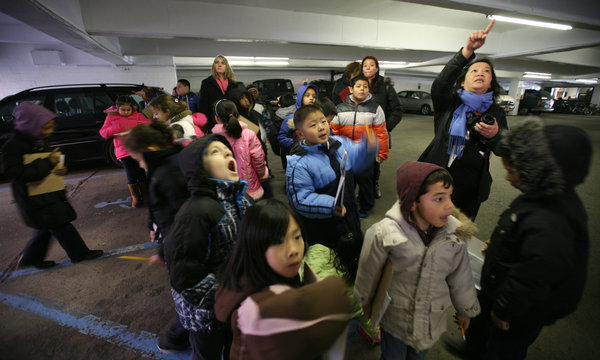
 A Field Trip to a Strange New Place: Second Grade Visits the Parking Garage from the NYTimes 2/12/2012
“…Ms. Krings recommends consulting an expert, so they asked the man standing in the front booth, whose name was David.”
 As a teacher, the most important asset I can teach my students is a love of learning. In my 10 years teaching high school, I have found that making a deliberate and transparent effort to continue my own learning allows me to inspire my students to follow my footsteps.
Here are some best practices that I have created for myself, to facilitate both my own learning and my students’ passion to learn. Click here to read Why Great Teachers Are Also Learners.
Developing an Innovation Ecosystem for Education and click here to read similar reports from the Innovation Unit.
Increasing meaningful student engagement from Paul Hamlyn Foundation. Teacher’s Guide to Project-based Learning
“Initiatives such as the RSA’s Opening Minds, among many others, seek to teach competences (or skills) looking at what young people might need to be able to do to effectively apply the knowledge they gain at school. By bringing such capabilities into the curriculum itself, both to demonstrate the relevance of the knowledge being imparted, and to develop young people’s capacity to use that knowledge, these initiatives seek to give all young people the opportunity to shape their worlds.
However, important critiques of these discourses emphasise the dangers of an education that seeks to form personalities and identities in order to create perfect citizens and economic operatives. By suggesting that young people must use what is learned at school in a certain way, for certain ends (sustainability for example), the curriculum could become an agent that denies young people real freedom for self determination and creative thought.
How do we move beyond this impasse? How do we equip young people to exercise agency without determining how that agency should be used and to what end? What does a curriculum that is designed explicitly with young peoples’ agency in mind look like?”
Click here to read more. Take a look at the RSA Education Seminars Report.
An Area Based Curriculum is one that is co-designed and co-owned by schools and other partners in the community. It takes into account a variety of views about what it is important to know, and is taught by teachers and community members together, inside school and in other locations in the local area.
Any school curriculum must of course take the National Curriculum and national qualifications into account, as well as ensure that the professional role of the teacher is respected. An Area Based Curriculum must do all of this, but in addition ensure that it challenges and questions the following:
1. The people involved: re-imagining who can be involved with education, and in what ways, by engaging a wider community in curriculum development
2. The places where learning happens: re-imagining the role of a place in educating young people by establishing the whole area as a learning environment
3. What it is important to know: re-imagining where knowledge is created and found by exploring the context of a place.
Click here to read more from RSA. And read the Lessons-for-localism Report.
”The reasonable man adapts himself to the world: the unreasonable one persists in trying to adapt the world to himself. Therefore all progress depends on the unreasonable man.” GEORGE BERNARD SHAW
Unreasonable Institute | We accelerate ventures that will define progress in our time.
 “What’s Wrong with the Teenage Mind?” by Alison Gopnik, Wall Street Journal, 1/28/2o12
“If you think of the teenage brain as a car, today’s adolescents acquire an accelerator a long time before they can steer and brake.”
“Our social and cultural life shapes our biology.”
The crucial new idea is that there are two different neural and psychological systems (the first system involving emotion and motivation and the second system has to do with control) that interact to turn children into adults. “Recent studies in the neuroscientist B.J. Casey’s lab at Cornell University suggest that adolescents aren’t reckless because they underestimate risks, but because they overestimate rewards—or, rather, find rewards more rewarding than adults do. ” What teenage desire most is social reward. The development of the second system requires learning through experience. The issue in contemporary society is that puberty kicks in earlier along with emotional energy/angst while social and cultural life limits opportunities for adult-supervised experience.
The Five Cs, Plus One by Pat Bassett NAIS Bassett Blog 11/9/2012
The “Five Cs” of critical thinking, creativity, collaboration, communication, character and the bonus “Sixth C” I’ve recently added: cosmopolitanism (cross-cultural competency)
Now that most of our schools have finished “backward designing” and “mapping” subjects (math, language arts, science, foreign language, social studies/history, the arts, etc.), it’s time to do so for the six Cs: What’s your K-12 creativity map? Your collaboration map? Your character map? Your cosmopolitanism/cross-cultural competency map?
“The C.E.O. in Politics” by David Brooks, New York Times, Jan. 12, 2012,
http://www.nytimes.com/2012/01/13/opinion/brooks-the-ceo-in-politics.html
The traits of successful presidents:
“They are resilient when things go wrong. They know how dependent they are on others, how prone they are to overconfidence. They are both modest, because they have felt weakness, and aggressive, because they know how hard it is to change anything. ”
“…Isaiah Berlin defines political judgment as “a capacity for integrating a vast amalgam of constantly changing, multicolored, evanescent perpetually overlapping data.” A president with political judgment has a subtle feel for the texture of his circumstance. He has a feel for where opportunities lie, what will go together and what will never go together.”
 INNOVATIVE LEARNING